


Benjamin - Earn Cash Rewards
3.628.50K Reviews
App Specs
- Version
- 4.22.1
- Updated On
- License
- Free
- Downloads
- 1,000,000+
- Developer
- Benjamin Capital Partners, Inc
- Categories
- Shopping
- Platform
- Android
Screenshots

 Analysis by AppCompare
Benjamin - Earn Cash Rewards is an app for people who would rather turn spare phone time into small cash rewards than scroll without a purpose. I tested it with that expectation, and my main conclusion is straightforward: it can be an enjoyable way to add a little value to idle moments, but it should be treated as a rewards activity, not as a dependable income source. Its appeal comes from combining games and surveys in one shopping-focused app, while its biggest challenge is that the usefulness of each activity depends on how much time you are willing to give it.
The app is free to use and comes from Benjamin Capital Partners, Inc. It has reached over a million installs, which gives it a substantial user base, although its average rating sits at 3.6 from around 131 thousand ratings. That combination tells me the experience is worthwhile for some people but not consistently smooth for everyone. I would not install it expecting a guaranteed result after a few minutes. I would install it as a low-commitment experiment and judge whether the available tasks fit my routine.
How the rewards experience feels in everyday use
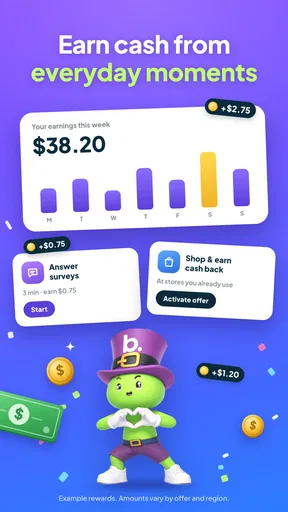
The central idea is easy to understand. Instead of using a separate app for mobile games and another for paid surveys, Benjamin places both activities under one rewards-oriented experience. That variety matters because surveys can become repetitive, while games may require more patience before they feel worthwhile. Switching between the two gives the app a better chance of fitting different moods and different amounts of free time.
My preferred way to use an app like this is in short, clearly defined sessions. I might check for a survey while waiting for a train, then try a game when I have a longer break at home. This approach is better than opening it whenever I feel bored and losing track of time. The rewards may feel small compared with the attention required, so a simple personal rule helps: only continue an activity when the progress feels reasonable for the time being spent.
That is the first important trade-off. Benjamin can make downtime feel more purposeful, but it does not remove the opportunity cost of that downtime. A game may be entertaining, yet the reward element can tempt me to continue after the activity has stopped being fun. Surveys can be convenient, but answering questions carefully takes attention. I found the app most appealing when I viewed the reward as a bonus attached to an activity I was already willing to do.
Games are better for longer, relaxed sessions
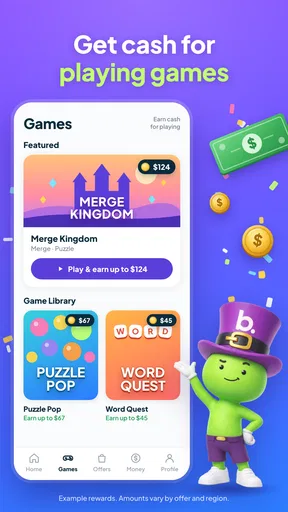
Games are the more natural choice when I want something interactive rather than a sequence of questions. They can make the process less monotonous, especially for someone who already enjoys trying casual mobile titles. The drawback is that game-based progress generally asks for more sustained attention. If I only have a minute or two, opening a game is less practical than checking whether a short survey is available.
A useful workflow is to separate discovery from commitment. I would first look at the available game opportunity and understand what kind of time investment it seems to require. If the activity looks like something I would enjoy anyway, it may be worth trying. If it feels like a chore from the beginning, I would move on rather than forcing myself through it just because a reward is visible.
Worth Reading Before You Choose

EA SPORTS FC Mobile 26 Is a Bigger Football Game, but It Takes Time

Flipboard Shows What News Apps Must Do Beyond the Feed

Switching to Android Auto Means Rethinking Your Driving Routine

Google Calendar Makes a Crowded Week Easier to Manage

Ludo King Makes the Most of the Minutes Between Plans

Baby Panda World Brings Quick Play to Modern Phones, but Its Game Library Feels Busy
This is also where Benjamin differs from ordinary mobile gaming. A normal game can be chosen entirely for its entertainment value, while a rewards app adds another reason to continue. That extra motivation can be helpful, but it can also make a mediocre game feel more important than it really is. I recommend keeping entertainment as the first filter and the reward as the second.
Surveys suit short gaps, but patience matters
Surveys are more convenient when I have limited time, although they can be less predictable. A questionnaire may look suitable and then take longer than expected, or it may not match my profile closely enough to be useful. I would avoid starting one when I need to leave immediately. A rushed answer is frustrating, and it is not a good way to evaluate whether the activity deserves another try.
The best practical habit is to answer consistently and read each question instead of tapping through automatically. Survey systems often use screening questions, so an early ending is not necessarily a sign that the app is broken. Still, repeated screening can make the experience feel inefficient. If surveys regularly interrupt my routine without producing satisfying progress, I would rely more on the gaming side or stop using the app.
Benjamin is therefore more flexible than a survey-only service, but that flexibility does not guarantee a steady stream of worthwhile tasks. I like having two formats to choose from, yet users should expect availability and effort to vary. The app works best for someone who can accept an uneven rhythm rather than someone who wants a predictable daily earning schedule.
What the rating and audience profile suggest
The public response is mixed rather than disastrous. An average of 3.6 indicates that many users find enough value to keep the app relevant, while others encounter friction that affects their opinion. I see that as a reason to approach it with realistic expectations, not as an automatic warning to avoid it. Rewards apps are especially sensitive to differences in patience, activity availability, and personal expectations.
The mature 17+ age classification is important for families. I would not present Benjamin as a general-purpose app for younger teenagers, and parents should pay attention to the age guidance before allowing access. The app is aimed at an older audience, which also makes it more appropriate for adults who understand that rewards activities involve exchanging time and attention for potential benefits rather than receiving free money without effort.
The current version is 4.22.1, and the app supports Android 7.0 or later. That makes it accessible on many older Android phones, which is useful for people who do not upgrade devices frequently. At the same time, support for an older operating system does not guarantee an equally smooth experience on every phone. Performance, screen size, and general device condition can still affect how comfortable games and surveys feel.
Where Benjamin has a real advantage
The strongest feature is the combination of activities. A single-purpose survey app can become useless when there are no suitable questionnaires, and a game-reward app can become tiring when its available titles do not appeal to me. Benjamin gives me another route when one format is not attractive. That does not solve every availability problem, but it makes the app less one-dimensional.
The free entry also lowers the risk of trying it. I do not have to commit money before deciding whether the experience suits me. For a user who already plays casual games or occasionally answers surveys, that is a meaningful benefit. The app can fit around existing habits instead of demanding a major change in routine.
Another strength is psychological rather than technical: the app gives idle time a clear boundary. If I decide in advance to use it during a commute or while waiting for an appointment, I can stop when the break ends. That makes it easier to keep the experience under control. In my view, this is more valuable than chasing every available activity throughout the day.
The limitation that matters most
The main weakness is the uncertain relationship between time and reward. The store summary presents an appealing idea, but the practical value depends on the activity available at the moment, how quickly I progress, and whether I enjoy the task enough to continue. Someone looking for reliable earnings may become disappointed because the app is better understood as a casual rewards tool than as work.
There is also a risk of overvaluing the word “cash.” A cash reward can sound like a direct replacement for ordinary income, but the experience still requires time. I would calculate the effort honestly: if an activity takes attention away from paid work, studying, rest, or family time, the reward may not justify it. Benjamin is most sensible when used during time that would otherwise be unproductive.
The mixed rating reinforces that point. Some users may enjoy the selection of games and surveys, while others may find the process too slow or inconsistent. I would not judge the app after one unusually good session or one disappointing task. A fair test is to use it casually across several ordinary breaks and then decide whether the experience feels worthwhile for me.
Privacy and attention are also worth considering in practical terms. Any app built around surveys and rewards asks me to spend time sharing responses and engaging with promotional activities. I would read each screen carefully, avoid giving information I am uncomfortable sharing, and remember that convenience should not replace basic judgment. The app may be suitable for casual participation, but it is not a reason to ignore personal boundaries.
How it compares with familiar alternatives
Compared with ordinary shopping apps, Benjamin is less useful for browsing products and more focused on turning participation into rewards. It is not the right choice if my main goal is to compare prices, manage orders, or find a retailer. Its shopping category describes the broader rewards context, but the day-to-day experience is centered on games and surveys rather than conventional shopping tools.
Compared with a dedicated survey app, Benjamin has the advantage of variety. I can switch to a game when questionnaires are unavailable or uninteresting. The trade-off is that the experience may feel less focused. A survey specialist may be preferable for someone who wants only questionnaires and is willing to accept a narrower format.
Compared with a standard mobile game, Benjamin adds a reward-oriented purpose but may not offer the same depth or consistency as a game selected purely for entertainment. If I want a rich story, competitive system, or long-term game community, I would choose a dedicated title instead. Benjamin makes more sense when the activity itself is secondary and the possibility of a reward is part of the appeal.
Compared with cashback services, it serves a different habit. Cashback is usually tied to purchases I already intend to make, while Benjamin asks me to spend time playing or answering questions. I would choose cashback when I am already shopping, and I would choose Benjamin when I have spare time and want an interactive alternative to passive scrolling. Using that distinction prevents me from expecting one type of reward app to behave like another.
Who should use it, and who should skip it
I think Benjamin is a good fit for adults who enjoy casual games, do not mind occasional surveys, and can use the app during genuinely free moments. It is especially suitable for someone who wants one place to try both formats instead of maintaining several separate rewards apps. The free price makes experimentation simple, provided the user is comfortable with the mature age classification.
It may also suit people with older Android phones, since the minimum operating system is Android 7.0. I would still keep expectations modest on an aging device, particularly if games feel demanding or the phone has limited storage and battery life. The app is accessible, but accessibility is not the same as a guarantee of perfect performance on every handset.
I would skip it if I need dependable income, dislike advertising-oriented activities, or find surveys and casual games tedious. I would also skip it if I tend to continue tasks long after they stop being enjoyable simply because I have already invested time. That personality pattern can turn a small reward into a poor exchange.
For parents searching for something suitable for children, the 17+ rating is a clear reason to look elsewhere. For users who want shopping discounts without spending extra time on activities, a cashback-focused alternative may be a better match. Benjamin is not a universal rewards solution; its value depends heavily on whether its particular mix fits the user.
Small habits that make the experience more worthwhile
My first tip is to set a session limit before opening the app. A short break can easily expand when a game offers another milestone or a survey appears at the right moment. A timer keeps the reward from taking over the purpose of the break and helps me compare the experience fairly with other uses of my time.
My second tip is to alternate formats instead of forcing one. If surveys feel repetitive, I would try a game only when I genuinely want to play. If a game feels too slow, I would return to surveys during shorter gaps. This simple rotation is more effective than treating every available activity as equally valuable.
My third tip is to keep a mental record of effort, not just progress. I would notice how long an activity takes, whether it is enjoyable, and whether it fits naturally into my day. That gives me a better personal measure than focusing only on the reward label. The app’s real value is individual: a task that feels worthwhile during a commute may feel wasteful during a busy evening.
Finally, I would avoid installing it with the expectation that every session must produce something. Availability can change, and not every opportunity will be a good match. Being willing to close the app is part of using it well. The strongest users are not the ones who chase every task; they are the ones who recognize when the exchange no longer makes sense.
My verdict after weighing the trade-offs
Benjamin - Earn Cash Rewards is a reasonable free option for adults who want to experiment with earning small rewards through mobile games and surveys. Its biggest strength is the choice between two activity types, while its biggest weakness is that time value and task quality can vary. I appreciate the flexibility, but I would never describe it as a substitute for regular work or a guaranteed source of money.
The app earns a recommendation for the right audience: patient users with spare moments, realistic expectations, and an interest in casual participation. It is less convincing for anyone seeking predictable returns, deep gaming, conventional shopping tools, or a child-friendly experience. My final advice is to try it with a clear time limit, compare the enjoyment with the effort, and keep it only if the rewards feel like a pleasant extra rather than the reason to sacrifice valuable time.
Pros
- Simple tasks make it easy to earn small rewards in your spare time.
- Cashback offers can add value when shopping through supported partners.
- The app provides multiple ways to collect points and rewards.
- Progress toward rewards is easy to track within the account.
- Suitable for users looking for a low-effort side-earning option.
Cons
- Earnings are generally modest and may not justify extensive time spent.
- Available tasks and offers can vary by location and user profile.
- Some rewards may require reaching a minimum redemption threshold.
- Partner promotions can expire or change without much notice.
- Personal and shopping data may be required to access certain offers.
FAQs for Benjamin - Earn Cash Rewards
What is Benjamin - Earn Cash Rewards?
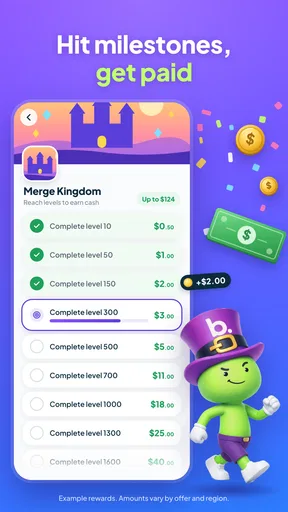
Benjamin - Earn Cash Rewards is a rewards app that lets users earn money or gift-card-style rewards by completing activities such as playing selected games, trying apps, answering surveys, and reaching specific milestones. Available tasks, reward amounts, and eligibility can vary by location, device, and account, so it is important to review each offer’s requirements before starting.
How do you earn rewards with Benjamin?
After creating an account, you can browse the available offers in the app and choose activities that match your interests. Some offers may require installing a game, completing levels, watching content, or answering questions. Tracking usually depends on opening the offer through Benjamin and meeting every listed condition, including deadlines and minimum activity requirements.
How are rewards redeemed in Benjamin - Earn Cash Rewards?
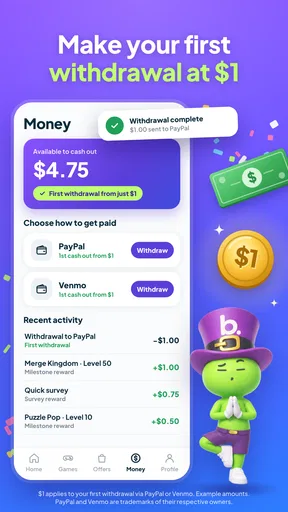
The redemption process depends on the options currently offered in your account and region. Users may need to reach a minimum balance, verify their identity or account details, and select an available payout method. Processing times can differ, and rewards may be reviewed before approval. Always check the app’s current withdrawal rules before investing significant time in an offer.
Is Benjamin - Earn Cash Rewards free to use?
Downloading and using the app is generally free, but some advertised activities may involve third-party games, subscriptions, purchases, or optional in-app spending. An offer should clearly state its conditions, yet users should read the fine print carefully and avoid paying money solely to qualify for a reward. Never share payment information unless you fully understand the associated terms.
What should I do if an offer or reward is not tracked?
If an activity does not appear correctly, first confirm that you opened it through Benjamin, used the required device and account, disabled anything that blocks tracking, and completed the task within the stated time limit. Keep screenshots, receipts, and other proof of completion, then contact in-app support with the offer details. Approval is not guaranteed if a requirement was missed.


